
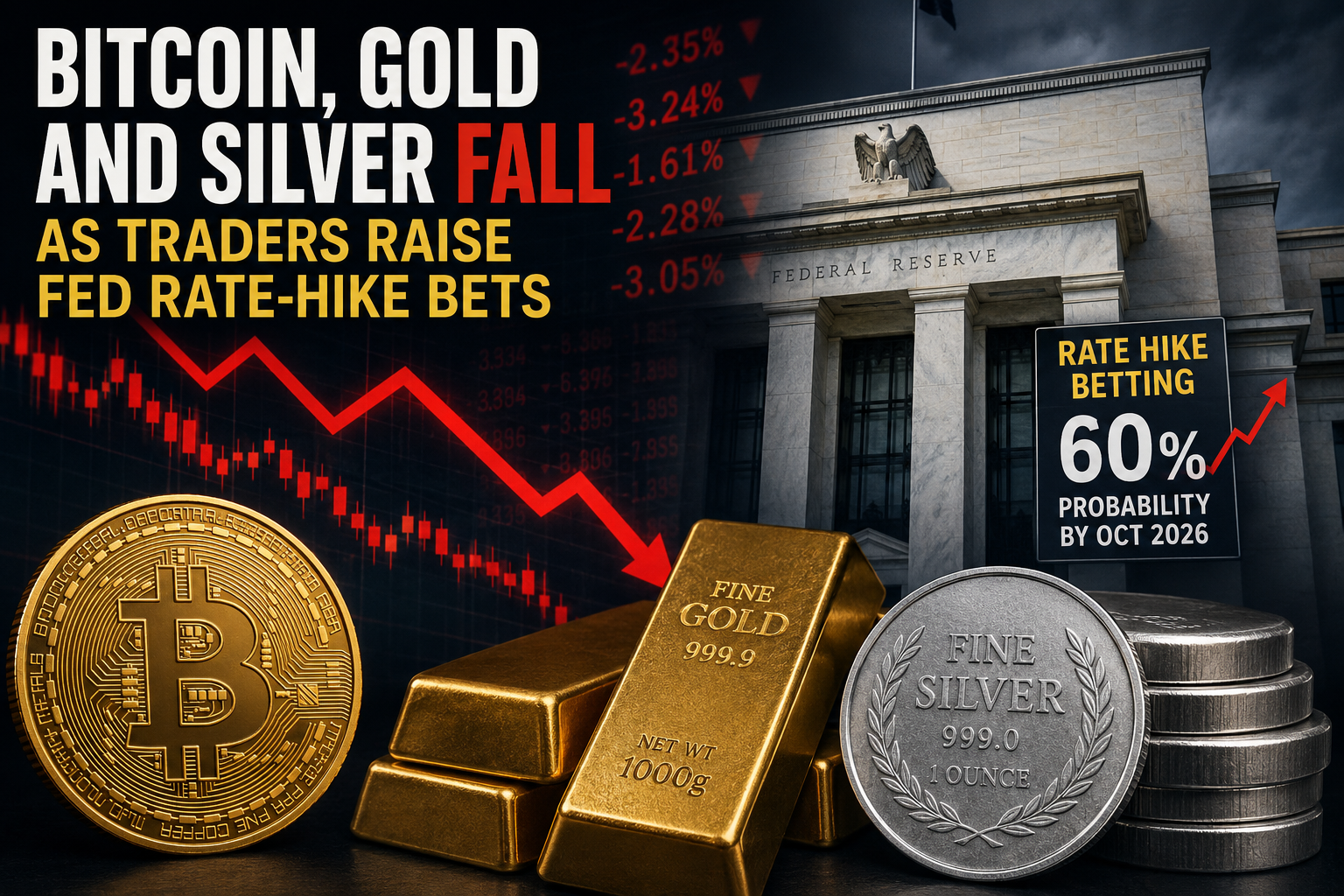
Bitcoin, gold and silver fell together as traders increased bets that the Federal Reserve may need to raise interest rates again, turning the move into a broad macro selloff rather than a crypto-only decline.
The CNBC headline framed the core market event clearly: “Gold, silver and bitcoin fall as traders up Fed rate hike bets.” The market reaction was confirmed by CoinDesk, which reported that Bitcoin traded at $61,233 on Wednesday, June 10, down 3% over 24 hours and 6.9% on the week, while gold fell 2% to below $4,200 an ounce.
That matters because Bitcoin did not fall in isolation. Gold and silver also moved lower, showing that traders were repricing a wider group of assets exposed to interest-rate expectations, inflation pressure and tighter liquidity.
Fed Rate-Hike Odds Move Back Into Focus
The immediate driver was the market’s renewed belief that U.S. monetary policy may become tighter. Reuters reported on June 10 that traders in short-term U.S. interest-rate markets saw about a 60% probability of a Fed rate hike by the October 2026 meeting, even after May inflation data came in broadly in line with expectations.
That pricing is important because the Fed’s policy path affects the relative appeal of every major asset class. When traders expect higher rates, yield-bearing assets such as Treasury bills, money-market funds and short-term bonds become more attractive.
Bitcoin, gold and silver do not pay interest. Because of that, they become more vulnerable when investors can earn higher yields elsewhere with less volatility.
Gold’s Drop Highlights the Opportunity-Cost Problem
Gold’s decline showed how quickly safe-haven assets can lose support when rate expectations rise. The Wall Street Journal reported that front-month Comex gold for June delivery settled 3.56% lower at $4,108.20 per troy ounce on June 10, a drop of $151.80. The report said it was gold’s largest one-day decline in both dollar and percentage terms since March 26, 2026.
That selloff also extended a broader decline. Gold had fallen for four consecutive sessions, losing 8.21% over that period, while remaining down 22.75% from its January 2026 record high of $5,318.40.
The logic is straightforward. Gold is often used as an inflation hedge, but it produces no income. When real yields or expected policy rates rise, investors face a higher opportunity cost for holding it.
Silver Weakness Confirms the Pressure Was Broader
Silver also joined the decline, confirming that the pressure was not limited to Bitcoin or gold. The Wall Street Journal reported that Comex silver settled 0.76% lower at $64.599 per ounce on June 10. It also said silver was down 12.44% over four sessions, marking its lowest close since December 2025.
Silver is especially exposed in this kind of environment because it carries both monetary and industrial characteristics. Like gold, it does not pay interest. But unlike gold, silver is also tied to industrial demand expectations, which can weaken when traders fear tighter policy and slower growth.
Because of that dual role, silver can suffer when the market shifts from inflation hedging to rate-hike fear. Higher rates pressure the investment case, while slower-growth concerns pressure the industrial-demand case.
Bitcoin Trades Like a Macro Asset, Not Just a Crypto Asset
Bitcoin’s decline alongside metals shows how deeply BTC has become connected to macro trading. CoinDesk described the move as a rate-hike bet hitting “every hedge,” with Bitcoin’s rebound from the previous week’s low rolling over while gold fell at the same time.
That is significant because Bitcoin is often marketed as “digital gold.” Supporters argue that its fixed supply makes it attractive during inflation, currency debasement and monetary uncertainty.
But the latest price action shows that scarcity alone does not protect BTC from rate pressure. When traders focus on higher yields and tighter liquidity, Bitcoin can behave less like a pure store-of-value asset and more like a high-beta macro asset.
That is especially true now that Bitcoin trades through ETFs, derivatives, corporate treasury vehicles and institutional risk models. These structures connect BTC more directly to the same liquidity cycle that affects equities, bonds, commodities and precious metals.
Inflation Keeps the Fed From Sounding Dovish
The renewed rate-hike debate is tied to inflation. Reuters reported that May consumer inflation rose 4.2% from a year earlier, keeping pressure on the Fed even though traders slightly reduced odds of a September move after the data.
MarketWatch also reported that gold entered a bear market after futures fell 3.6% to $4,133.30 per ounce, with the metal down more than 20% from its March peak of $5,354.80. The same report linked the decline to rising U.S. interest-rate expectations after the 4.2% inflation reading.
This is the central macro problem for Bitcoin, gold and silver. If inflation remains too high, the Fed has less room to ease policy. If the Fed cannot ease, liquidity-sensitive assets lose one of their most important support mechanisms.
The FedWatch Signal Matters for Traders
CME’s FedWatch tool is widely used because it tracks the probabilities of changes to the federal funds rate as implied by 30-Day Fed Funds futures prices. CME specifically says media should attribute those rate probabilities to “CME FedWatch.”
That matters because rate-hike expectations are not just analyst opinions. They are embedded in futures-market pricing. When those probabilities rise, traders across asset classes adjust portfolios quickly.
For Bitcoin, that can mean reduced leverage, weaker ETF demand and lower risk appetite. For gold and silver, it can mean liquidation from investors who prefer yield-bearing alternatives while monetary policy remains restrictive.
Why the “Digital Gold” Narrative Is Being Tested
Bitcoin’s simultaneous decline with gold and silver creates a difficult narrative problem. If Bitcoin is digital gold, it should theoretically benefit from inflation concern and monetary uncertainty. But in this case, the market focused more on the Fed’s possible response to inflation than on inflation itself.
That distinction is critical. Inflation can support scarce assets if investors believe central banks will stay behind the curve. But if traders believe inflation will force higher rates, the reaction can flip. Instead of buying Bitcoin, gold and silver as inflation hedges, investors may sell them because tighter policy raises yields and drains liquidity.
That is why Bitcoin can fall even during an inflation scare. The market is not only asking whether inflation is high. It is asking whether the Fed will fight inflation with tighter policy.
Cross-Asset Selling Shows a Portfolio Repricing
The shared weakness in Bitcoin, gold and silver points to a broader portfolio repricing. Traders were not just reacting to one asset-specific headline. They were reassessing non-yielding and liquidity-sensitive assets as a group.
In this setup, Bitcoin is vulnerable because it depends heavily on risk appetite and liquidity. Gold is vulnerable because higher yields increase the cost of holding a non-yielding metal. Silver is vulnerable because it faces both rate pressure and possible growth concerns.
That is why the selloff matters beyond one trading session. It shows that Bitcoin is increasingly part of the same macro basket as precious metals and other assets sensitive to real rates.
What Could Stabilize Bitcoin, Gold and Silver
For Bitcoin, gold and silver to stabilize, the market likely needs a change in one of three areas.
The first is softer inflation data. If inflation cools, traders may reduce rate-hike expectations, easing pressure on non-yielding assets.
The second is a less hawkish Fed message. If policymakers signal patience rather than additional tightening, investors may become more willing to hold Bitcoin and metals again.
The third is renewed safe-haven demand. Reuters reported on June 11 that gold rebounded 0.6% to $4,097.01 per ounce, helped by short-covering, though rate-hike concerns continued to cap gains. Silver also rose 1.3% to $64.49 per ounce.
That rebound shows that sharp selloffs can create temporary relief rallies. But it does not prove that the macro pressure has disappeared.
Bottom Line
Bitcoin, gold and silver fell together because traders raised expectations for tighter Federal Reserve policy. The numbers show the breadth of the move: Bitcoin traded near $61,233, down 3% over 24 hours; gold fell below $4,200; Comex gold settled 3.56% lower at $4,108.20; and Comex silver settled at $64.599, down 12.44% over four sessions.
The market is treating all three assets as vulnerable to higher yields. Gold and silver are being pressured by the rising opportunity cost of holding non-yielding metals. Bitcoin is being pressured by the same rate logic, plus its sensitivity to liquidity and risk appetite.
Because of that setup, Bitcoin’s next move may depend as much on inflation data and Fed-rate expectations as on crypto-specific narratives. If rate-hike bets keep rising, BTC may struggle to trade like an independent store-of-value asset. If inflation cools or the Fed turns less hawkish, Bitcoin and precious metals could regain support from investors looking for scarce assets in an uncertain market.