
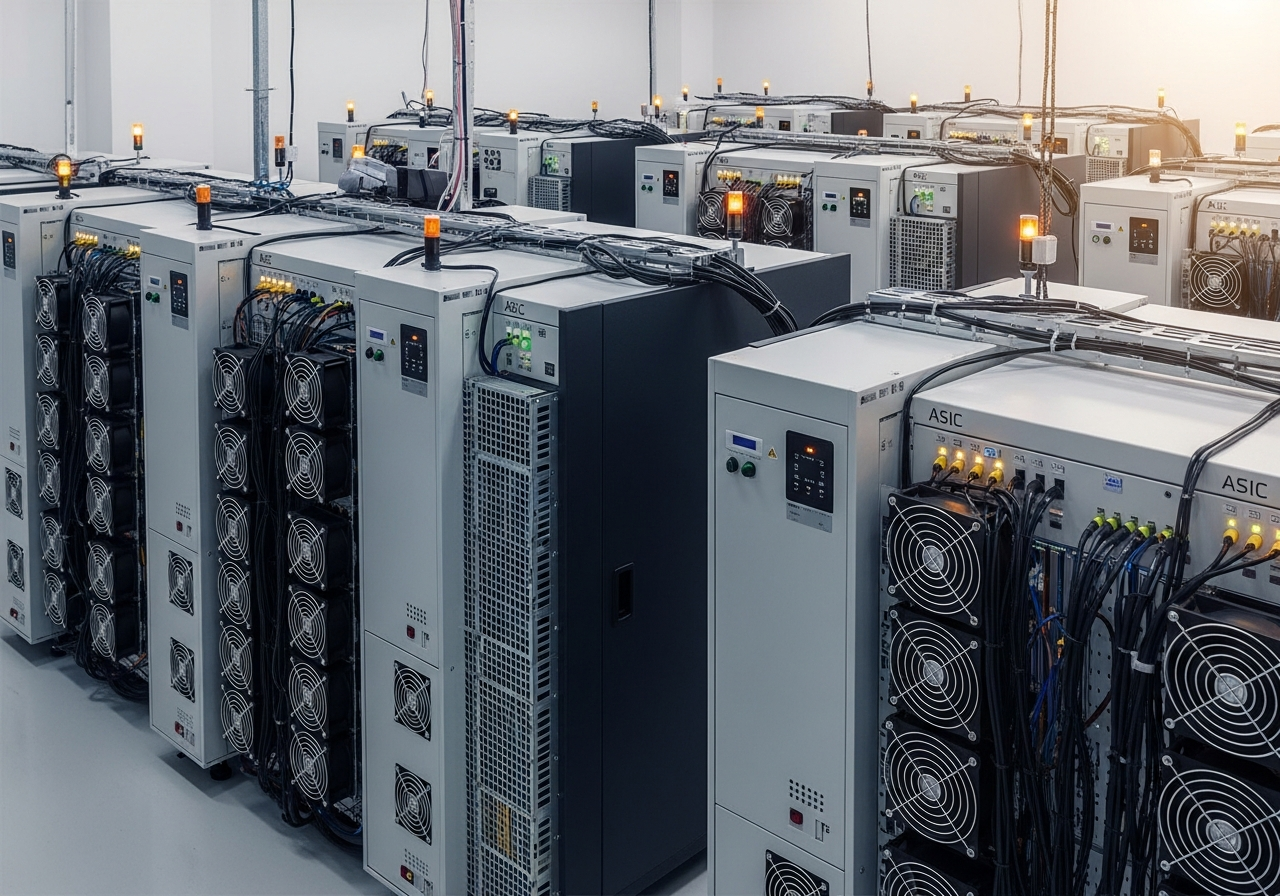
Bitcoin mining difficulty in 2026 sits at a challenging crossroads, hovering around 135-148 trillion with dramatic fluctuations that have left miners scrambling to adapt. Unlike the euphoric gold rush of 2025 when Bitcoin peaked at $125,000 and attracted a massive influx of new mining operations, the post-crash reality of 2026 presents a sobering landscape where only the most efficient operations survive.
The current mining environment is defined by several critical factors: a global hash rate struggling to maintain momentum below 1 zettahash per second, the reduced 3.125 BTC block reward following the 2024 halving, and electricity costs that now dominate over 70% of operational expenses. The network’s automatic difficulty adjustment mechanism continues to recalibrate every 2,016 blocks, creating a dynamic challenge that separates professional mining operations from hobbyist attempts.
What Is Bitcoin Mining Difficulty and How It Works
Bitcoin mining difficulty represents the computational challenge required to find a valid hash below a specific target, ensuring blocks are discovered approximately every 10 minutes. This metric directly correlates with the total network hash rate and serves as Bitcoin’s self-regulating mechanism to maintain consistent block production times regardless of the number of miners participating.
The network automatically adjusts difficulty every 2,016 blocks based on how quickly the previous blocks were mined, with the current pace running at approximately 9.95 minutes per block. Throughout 2026, we’ve witnessed significant volatility with difficulty peaking at 148 trillion in January before experiencing substantial drops to the 133-138 trillion range by April, reflecting the ongoing miner exodus following Bitcoin’s price correction.
These adjustments create a constantly shifting landscape where mining profitability can change dramatically within weeks. The recent trend shows difficulty attempting to stabilize in the mid-130s trillion range, though periodic spikes still occur when hash rate concentrations shift or major mining operations come online or go offline.
2026 Difficulty Fluctuations Timeline
The difficulty adjustments throughout 2026 tell a story of market turbulence and miner adaptation. Key events have shaped the current mining landscape, with major percentage swings reflecting the broader cryptocurrency market dynamics.
| Date/Event | Difficulty (T) | Change % | Hash Rate Context |
|---|---|---|---|
| January 2026 Peak | 148.2 | +12.4% | Post-holiday hash rate recovery |
| February Adjustment | 144.1 | +15.2% | Institutional mining expansion |
| March Crash Response | 133.4 | -7.76% | Mass miner shutdowns begin |
| April Stabilization | 138.2 | +3.6% | Efficient miners remain active |
| Current May Period | 135.7 | -1.8% | Seasonal power cost increases |
Why Difficulty Adjusts Automatically
The automatic difficulty adjustment serves as Bitcoin’s most elegant self-balancing mechanism, ensuring network stability regardless of external mining pressures. When miners join the network and blocks are found faster than the target 10-minute interval, difficulty increases proportionally to slow down block production.
Conversely, when miners leave the network due to unprofitability or external factors, difficulty decreases to maintain the target block time. This system prevents Bitcoin from becoming unusable during periods of low mining participation while also preventing inflation during mining booms, maintaining the predictable issuance schedule that underpins Bitcoin’s monetary policy.
Current 2026 Mining Difficulty Levels
The current difficulty landscape in 2026 reflects a market still recovering from the dramatic highs of 2025, when difficulty briefly touched 155 trillion during Bitcoin’s peak price period. Today’s levels represent a new equilibrium where only the most efficient mining operations can maintain profitability.
| Period | Difficulty (T) | YoY Change | Next Adjustment Est. |
|---|---|---|---|
| Q1 2026 Average | 141.9 | +18.2% | Completed |
| Current (May 2026) | 135.7 | +12.8% | -3.23% to 131.3T |
| 2025 Peak (Dec) | 155.1 | +28.5% | Historical Reference |
| Projected Q3 2026 | 128.5 | +6.9% | Seasonal decline expected |
Impact on Block Times
The current difficulty of 135.7 trillion at block height 946,000 has resulted in relatively stable block times averaging 9.8 minutes over the past week. With approximately 1,200 blocks remaining until the next adjustment, the network is tracking toward another modest difficulty reduction as hash rate continues to normalize post-2025 crash.
These block time variations directly impact miner revenue streams, as faster blocks mean more frequent rewards but also signal impending difficulty increases. The current pace suggests miners are operating with reduced margins, carefully balancing operational costs against the expectation of continued difficulty volatility through the remainder of 2026.
Hash Rate Trends Making Mining Harder
The global Bitcoin hash rate in 2026 remains stubbornly below the 1 zettahash per second threshold, representing a 20-22% decline from the all-time highs reached during 2025’s bull market peak. This reduction reflects the harsh economic reality facing miners as they navigate reduced block rewards, elevated operational costs, and increased competition from institutional players who survived the market correction.
Despite the significant drop from peak levels, the current hash rate still represents a substantial increase compared to historical standards, indicating that Bitcoin mining has permanently evolved into an industrial-scale operation. The concentration of hash rate among well-capitalized miners has created new dynamics where efficiency improvements and economies of scale determine survival more than ever before.
Regional hash rate distribution has stabilized around major low-cost energy centers, with miners increasingly focused on renewable energy sources both for cost advantages and regulatory compliance. The post-2025 crash exodus eliminated many marginal operations, leaving behind a more professional and efficient mining ecosystem that operates with thinner margins but greater operational sophistication.
2025 Boom to 2026 Bust Cycle
The dramatic cycle from 2025’s mining boom to 2026’s more subdued environment illustrates the volatile nature of Bitcoin mining economics. The transition has been marked by several key phases that reshaped the entire industry structure.
- Peak influx period – During Bitcoin’s $125,000 price surge, new mining operations flooded the market with over-leveraged equipment purchases and rushed facility deployments
- September double adjustments – Two consecutive difficulty increases of 15%+ within a month as hash rate peaked above 1.2 ZH/s
- Institutional consolidation – Major mining companies expanded aggressively, acquiring distressed competitors and securing long-term energy contracts
- Price crash shutdowns – When Bitcoin fell below $80,000, approximately 35% of hash rate went offline within six weeks
- Efficiency culling – Older generation ASICs became permanently unprofitable, forcing widespread hardware upgrades or shutdowns
- Geographic redistribution – Mining operations relocated to jurisdictions with the most favorable energy costs and regulatory environments
Global Hash Rate Distribution
The current global hash rate distribution heavily favors regions with established energy infrastructure and clear regulatory frameworks. The United States maintains its position as the dominant mining jurisdiction, with Texas alone accounting for nearly 25% of global hash rate thanks to its deregulated energy market and pro-crypto stance.
Kazakhstan has emerged as the second-largest mining hub, leveraging abundant fossil fuel resources and relatively stable political conditions to attract major mining operations displaced from China’s 2021 ban. Other significant contributors include Canada’s renewable energy-rich provinces, Nordic countries capitalizing on hydroelectric power, and select Middle Eastern nations with energy surpluses looking to diversify their economies.
Profitability Challenges for Miners in 2026
The profitability landscape for Bitcoin miners in 2026 has become increasingly stratified, with clear advantages accruing to large-scale operations while smaller miners face existential challenges. Electricity costs now represent over 70% of operational expenses for most mining operations, compared to roughly 50-60% in previous years, fundamentally altering the economics of Bitcoin mining.
The reduced block reward of 3.125 BTC following the 2024 halving has compressed margins across the board, making efficiency improvements and cost optimization critical for survival. Industry data suggests that approximately 30% of North American small-scale operations that launched during 2025’s bull run have since closed, unable to maintain profitability at current Bitcoin prices and difficulty levels.
| Factor | Pro for Large Miners | Con for Small Miners |
|---|---|---|
| Electricity Procurement | Long-term contracts at $0.03-0.04/kWh | Retail rates often $0.08-0.12/kWh |
| Hardware Access | Direct manufacturer relationships, bulk discounts | Higher per-unit costs, limited availability |
| Operational Efficiency | Dedicated staff, optimized cooling systems | Limited technical expertise, manual management |
| Capital Access | Low-cost financing, strategic investments | High-interest loans or personal funding |
| Regulatory Compliance | Dedicated legal teams, policy influence | Compliance burden, regulatory uncertainty |
| Market Volatility | Hedging instruments, diversified revenue | Direct price exposure, limited risk management |
Break-Even Analysis Factors
The break-even analysis for Bitcoin mining in 2026 has become increasingly complex, with Bitcoin price volatility serving as the primary variable that determines operational viability. Most efficient operations require Bitcoin prices above $75,000 to maintain positive cash flow at current difficulty levels, while less efficient miners need prices exceeding $90,000 to break even.
Beyond price considerations, miners must account for difficulty adjustment predictions, seasonal energy cost variations, and equipment depreciation schedules. The thin margins characterizing the current environment mean that a single unfavorable difficulty adjustment can push marginal operations into losses, while unexpected price rallies can quickly restore profitability. This dynamic has forced miners to develop more sophisticated financial models and risk management strategies.
Hash rate efficiency measured in joules per terahash has become the most critical operational metric, with modern operations targeting sub-25 J/TH performance to maintain competitiveness. The rapid obsolescence of older equipment means that miners must continuously reinvest in hardware upgrades, creating a constant capital expenditure pressure that many smaller operations cannot sustain long-term.
Hardware and Efficiency Requirements
The hardware requirements for competitive Bitcoin mining in 2026 have reached new levels of sophistication, with only the most advanced ASIC miners capable of generating positive returns in the current environment. The efficiency arms race has intensified to the point where miners operating equipment more than 18 months old face severe disadvantages, as newer generations deliver 15-20% efficiency improvements annually.
Modern mining operations must master not only hardware selection but also firmware optimization, with custom tuning becoming essential for maximizing performance per watt. The integration of advanced cooling solutions, power management systems, and automated monitoring tools has transformed mining from a simple plug-and-play operation into a complex technical endeavor requiring specialized expertise.
- Latest generation ASICs only – Equipment manufactured before 2025 generally cannot achieve profitability at current difficulty and energy costs
- Sub-25 J/TH efficiency targeting – Modern operations require miners achieving less than 25 joules per terahash for competitive performance
- Custom firmware implementation – Standard firmware configurations rarely optimize the power-to-hash ratio for specific operational conditions
- Advanced cooling infrastructure – Immersion cooling or sophisticated air handling systems necessary for high-density deployments
- Automated monitoring systems – Real-time performance tracking and fault detection critical for minimizing downtime costs
- Power supply optimization – High-efficiency PSUs (94%+ efficiency) and power factor correction essential for operational margins
- Environmental controls – Temperature, humidity, and air quality management directly impact hardware longevity and performance stability
Top ASIC Efficiency Metrics
The current generation of ASIC miners represents significant technological advancement over previous generations, with leading manufacturers achieving efficiency levels that seemed impossible just two years ago. These improvements have been crucial for miner survival in the compressed-margin environment of 2026.
| Model | Hash Rate (TH/s) | Power (W) | J/TH |
|---|---|---|---|
| Antminer S21 Pro | 234 | 3,510 | 15.0 |
| WhatsMiner M63S+ | 390 | 7,800 | 20.0 |
| AvalonMiner 1566 | 185 | 3,420 | 18.5 |
| Antminer S19 XP (2024) | 140 | 3,010 | 21.5 |
Home Mining Viability
Home-based Bitcoin mining in 2026 has become increasingly challenging for individual miners, with profitability rarely achievable without access to extremely low-cost or free electricity. The combination of high difficulty levels, sophisticated commercial competition, and residential electricity rates typically exceeding $0.10 per kWh makes home mining a losing proposition for most participants.
The few successful home miners tend to have unique advantages such as solar installations with battery storage, access to time-of-use electricity rates that allow mining during off-peak hours, or creative heat recovery systems that provide additional value from mining operations. Even in these optimal scenarios, margins remain thin and require constant attention to difficulty adjustments and Bitcoin price movements to maintain profitability.
Strategies to Stay Profitable
Surviving and thriving in the challenging Bitcoin mining environment of 2026 requires a multi-faceted approach that combines operational efficiency, cost management, and strategic positioning. Successful miners have adapted by implementing comprehensive optimization strategies that address every aspect of their operations from energy procurement to hardware management.
- Secure long-term power contracts – Negotiate fixed-rate electricity agreements below $0.05/kWh to protect against energy market volatility and ensure predictable operational costs
- Implement auto-tuning firmware – Deploy custom firmware solutions that automatically adjust mining parameters based on real-time profitability calculations and environmental conditions
- Maximize waste heat utilization – Integrate mining operations with greenhouse heating, residential warming, or industrial processes to extract additional value from energy consumption
- Join established mining pools – Participate in large pools to reduce variance and ensure steady revenue streams rather than gambling on solo mining rewards
- Relocate to low-cost jurisdictions – Consider geographic arbitrage opportunities in regions with abundant renewable energy and favorable regulatory environments
- Diversify revenue streams – Explore additional services such as transaction acceleration, heat-as-a-service, or participation in demand response programs
- Implement predictive maintenance – Use IoT sensors and data analytics to prevent equipment failures and optimize replacement schedules for maximum uptime
Optimization Tools Comparison
The modern mining operation relies heavily on specialized software and tools to maintain competitiveness, with the choice of optimization platform often determining the difference between profit and loss. These tools have evolved significantly to address the complex operational challenges facing miners in 2026.
| Tool/Method | Benefit | Cost Impact |
|---|---|---|
| NiceHash Firmware | 5-8% efficiency improvement through auto-tuning | $50-100 per unit licensing |
| Immersion Cooling Systems | 20-25% power reduction, higher density | $15,000-25,000 initial setup per MW |
| Predictive Analytics Software | 95%+ uptime through failure prediction | $500-2,000 monthly subscription |
| Dynamic Load Management | Peak shaving, demand response revenue | $5,000-8,000 per site installation |
Security Benefits of High Difficulty
The elevated mining difficulty levels of 2026, despite creating profitability challenges for miners, provide unprecedented security benefits for the Bitcoin network as a whole. The computational power required to execute a 51% attack has never been higher, making Bitcoin more secure against malicious actors than at any point in its history. The current hash rate represents an investment of hundreds of billions of dollars in specialized hardware, creating an enormous economic barrier to network attacks.
High difficulty also serves as a powerful decentralization mechanism, encouraging geographic distribution of mining operations as miners seek the most cost-effective energy sources worldwide. This geographic spread reduces the risk of coordinated attacks or regulatory actions that could compromise network security, as taking down the Bitcoin network would require simultaneous action across multiple jurisdictions.
However, the same economic pressures that enhance security through high difficulty also create centralization risks as smaller miners are forced to exit the market. The increasing dominance of large mining corporations with superior access to capital and energy resources could potentially concentrate hash rate among fewer entities, though this trend is partially offset by the geographic distribution of these large operations across multiple countries and regions.
Centralization Risks
The mining landscape of 2026 presents a complex balance between security benefits and centralization concerns, with several factors working in opposing directions to shape network health.
- Enhanced network security – Record-high computational requirements make 51% attacks economically and practically infeasible for any known attacker
- Geographic diversification – Mining operations spread across multiple continents reduce single-point-of-failure risks from regulatory or infrastructure issues
- Corporate consolidation concern – Fewer but larger mining entities could potentially coordinate actions, though economic incentives strongly discourage such behavior
- Pool concentration monitoring – Major mining pools maintain relatively balanced market share, with automatic monitoring systems alerting to dangerous concentration levels
- Technological barriers to entry – High capital requirements for competitive mining operations limit new participant entry, potentially reducing decentralization over time
Energy and Environmental Factors
The energy consumption profile of Bitcoin mining in 2026 has evolved significantly, with total network power consumption reaching new highs despite efficiency improvements in individual mining hardware. The increased hash rate and difficulty levels require more total computational power, even as each unit of computation becomes more energy-efficient through technological advancement.
Environmental sustainability has become a central concern for large mining operations, driven both by regulatory pressure and economic incentives favoring renewable energy sources. The majority of new mining facilities are being developed around hydroelectric, solar, and wind power sources, with some operations achieving over 90% renewable energy usage. This shift toward green energy has created new geographic mining hubs in regions with abundant renewable resources, fundamentally altering the global distribution of Bitcoin mining operations.
Future Outlook for 2026 Mining
The remainder of 2026 promises continued evolution in the Bitcoin mining landscape, with several major trends likely to reshape the industry dynamics. Regulatory developments across key jurisdictions, technological breakthroughs in mining hardware, and the looming shadow of the 2028 halving are creating both challenges and opportunities for mining operations of all sizes.
The potential for hash rate recovery remains strong, particularly if Bitcoin prices stabilize above $85,000 or if breakthrough efficiency improvements make older equipment viable again. However, the increasing sophistication required for competitive mining suggests that the industry will continue consolidating around professionally managed operations with access to institutional capital and cutting-edge technology.
| Trend | Impact on Difficulty | Mining Opportunity |
|---|---|---|
| MiCA Compliance Requirements | Moderate decrease as EU miners upgrade systems | Advantage to compliant operations |
| US Tax Policy Changes | Potential 10-15% hash rate reduction | Offshore mining advantage |
| Institutional Adoption Wave | Significant increase if BTC >$100k | Corporate mining expansion |
| 2028 Halving Preparation | Gradual decline as miners prepare | Efficiency upgrade cycle begins |
| Next-Gen ASIC Launch | Sharp increase with 40%+ efficiency gains | Early adopter advantages |
| Energy Market Volatility | High volatility based on seasonal factors | Renewable energy premium |
Is Mining Worth It in 2026?
The question of whether Bitcoin mining remains worthwhile in 2026 depends heavily on operational scale, energy access, and risk tolerance. For professional mining operations with access to electricity below $0.04 per kWh, state-of-the-art equipment, and sufficient capital reserves to weather volatility, mining can still generate attractive returns, particularly when Bitcoin prices exceed $80,000.
However, for hobbyist miners or small-scale operations, the economic reality has become increasingly harsh. The combination of high difficulty, compressed margins, and the need for constant hardware upgrades has made small-scale mining largely uneconomical unless miners have access to free or extremely cheap electricity. The days of profitable home mining using consumer-grade equipment are effectively over, replaced by an industrial ecosystem that requires substantial capital investment and technical expertise.
For those considering entry into Bitcoin mining in 2026, the focus should be on developing competitive advantages in energy procurement, operational efficiency, or technological innovation rather than simply purchasing equipment and hoping for favorable market conditions. The mining industry has matured into a sophisticated sector that rewards professional management and punishes casual participation, making it essential for new entrants to understand the full scope of challenges before committing resources to mining operations.