
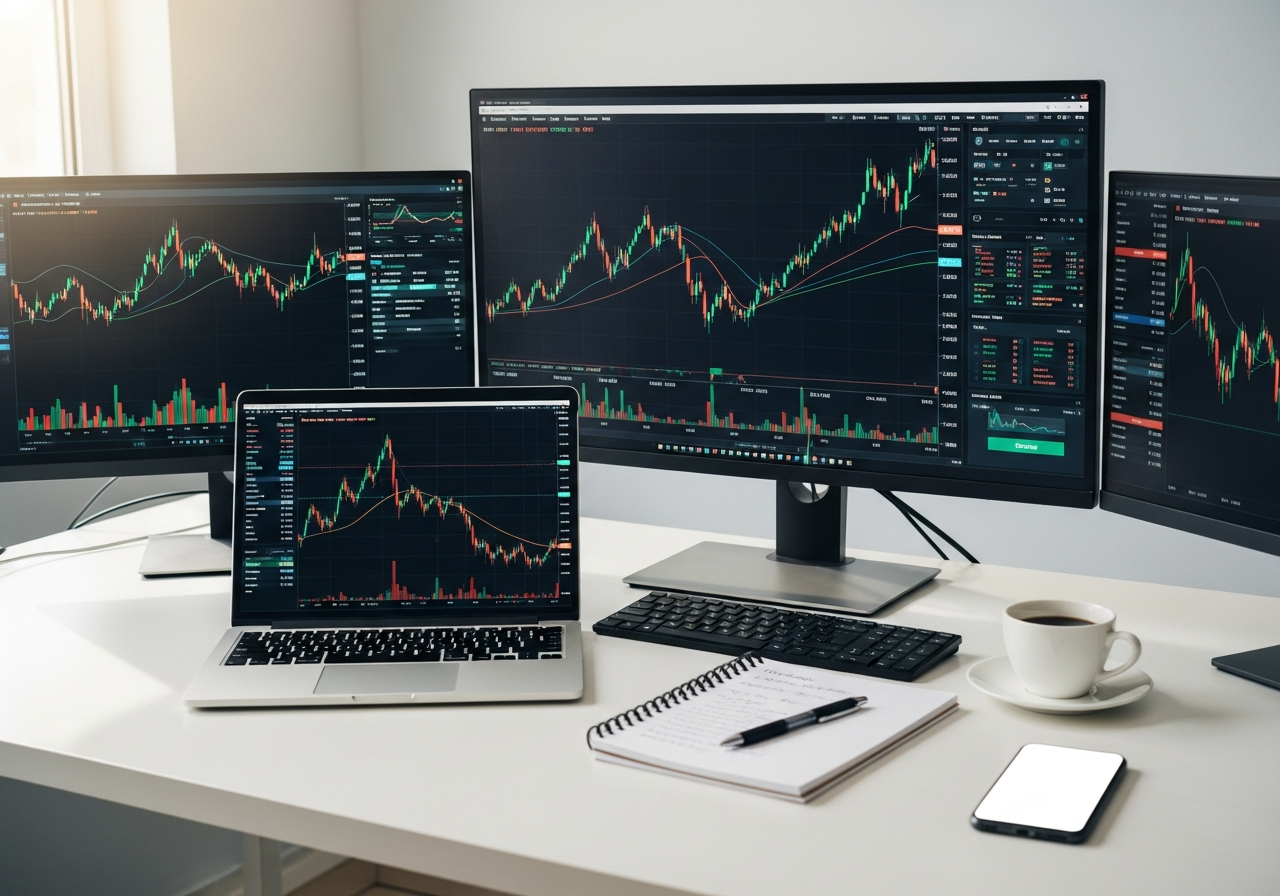
Bitcoin trading presents an exciting opportunity to profit from the world’s most established cryptocurrency, but success requires proper preparation and strategy. Unlike traditional investing where you buy and hold for years, trading involves actively buying and selling bitcoin to capitalize on price movements over shorter timeframes. This comprehensive guide will walk you through every step needed to start bitcoin trading safely, from choosing the right platform to executing your first trade.
Bitcoin’s incredible potential stems from its growing institutional adoption, limited supply of 21 million coins, and increasing mainstream acceptance as digital gold. However, trading differs significantly from long-term investing – it demands constant market monitoring, technical analysis skills, and disciplined risk management. The cryptocurrency market’s extreme volatility can lead to substantial gains or losses within hours, making it crucial to start small and never risk more than you can afford to lose. By following proven strategies and maintaining strict discipline, beginners can gradually build their trading skills while protecting their capital.
What Is Bitcoin Trading and Why Start Now?
Bitcoin trading encompasses two primary markets: spot trading, where you buy and sell actual bitcoin at current market prices, and derivatives trading, which involves contracts based on bitcoin’s future price movements. Spot trading is ideal for beginners as it’s straightforward – you purchase bitcoin when you expect prices to rise and sell when you anticipate declines. Derivatives like futures and options offer leverage but carry significantly higher risks unsuitable for novice traders.
Bitcoin’s current market trends make it an attractive trading asset, with institutional investors like Tesla, MicroStrategy, and major banks increasingly adopting bitcoin as a treasury asset. This institutional interest creates more predictable price patterns while reducing some long-term downside risk. However, volatility remains bitcoin’s defining characteristic – daily price swings of 5-15% are common, and extreme moves of 20-30% can occur during major news events or market corrections.
The cryptocurrency market’s 24/7 nature provides unique advantages over traditional stock markets, allowing you to trade bitcoin around the clock across global exchanges. This continuous trading creates more opportunities to profit from price movements and react quickly to breaking news. Unlike stock markets that close on weekends and holidays, bitcoin trading never stops, enabling flexible scheduling for part-time traders with day jobs.
Bitcoin vs Other Cryptos for Beginners
Bitcoin stands out as the most beginner-friendly cryptocurrency due to its market stability, widespread adoption, and extensive educational resources. While thousands of altcoins exist, most lack bitcoin’s proven track record and institutional backing, making them unsuitable for novice traders.
- Highest liquidity among all cryptocurrencies, ensuring easy buying and selling at fair market prices
- Most predictable price patterns due to extensive technical analysis data spanning over a decade
- Strongest regulatory clarity, with major governments treating bitcoin as a legitimate asset class
- Widest media coverage and analysis, providing abundant information for making informed trading decisions
- Lowest risk of total value loss compared to experimental altcoins that can become worthless overnight
- Simplest to understand fundamentally, without complex tokenomics or utility functions
Trading vs Holding Bitcoin
Trading bitcoin involves actively buying and selling to profit from short-term price movements, typically holding positions for minutes, hours, or days. This approach requires constant market monitoring, technical analysis skills, and quick decision-making under pressure. Successful trading can generate consistent income but demands significant time investment and carries higher tax implications due to frequent transactions.
HODLing (holding on for dear life) represents the long-term investment strategy of buying bitcoin and storing it securely for months or years, regardless of short-term price fluctuations. This passive approach requires minimal time commitment and historically outperforms most active trading strategies, but provides no regular income and requires patience during extended bear markets. Many successful bitcoin investors combine both strategies, holding a core long-term position while trading smaller amounts for additional profits.
Choose the Best Bitcoin Trading Platform
Selecting the right cryptocurrency exchange is crucial for successful bitcoin trading, as platform features, fees, and security measures directly impact your profitability and safety. The most reputable exchanges offer competitive trading fees, robust security protocols, regulatory compliance, and user-friendly interfaces suitable for beginners.
| Exchange | Fees | BTC Pairs | Beginner-Friendly | Regulation | Min Deposit |
|---|---|---|---|---|---|
| Coinbase Pro | 0.5% | BTC/USD, BTC/EUR | Excellent | US Licensed | $1 |
| Binance | 0.1% | 50+ pairs | Good | Global | $10 |
| Kraken | 0.26% | BTC/USD, BTC/EUR | Good | US Licensed | $1 |
| Gemini | 0.35% | BTC/USD, BTC/GUSD | Excellent | US Licensed | $1 |
| Bitstamp | 0.50% | BTC/USD, BTC/EUR | Good | EU Licensed | $20 |
| FTX | 0.10% | 30+ pairs | Fair | Offshore | $1 |
Key Features to Look For
When evaluating bitcoin trading platforms, prioritize exchanges that combine strong security measures with user-friendly interfaces and comprehensive educational resources. The most important features directly impact your trading success and account safety.
Advanced security protocols should include cold storage for user funds, insurance coverage against hacks, and mandatory two-factor authentication. Mobile app functionality enables trading on the go, while educational tools like market analysis, trading tutorials, and demo accounts help beginners develop their skills safely.
- Multi-layer security with cold storage, insurance, and withdrawal whitelist options
- Intuitive mobile app with full trading functionality and real-time price alerts
- Comprehensive educational resources including tutorials, webinars, and market analysis
- Advanced order types beyond basic market orders, including stop-loss and limit orders
- 24/7 customer support through multiple channels with reasonable response times
- Transparent fee structure with competitive trading costs and clear deposit/withdrawal policies
- Strong regulatory compliance and positive reputation within the cryptocurrency community
Step-by-Step: Set Up Your Trading Account
Creating a secure bitcoin trading account involves several verification steps designed to protect both you and the exchange from fraud and regulatory violations. Most reputable exchanges require identity verification through KYC (Know Your Customer) procedures before allowing trading.
- Visit your chosen exchange’s website and click the “Sign Up” or “Create Account” button
- Provide a valid email address and create a strong password with uppercase, lowercase, numbers, and symbols
- Verify your email address by clicking the confirmation link sent to your inbox
- Complete basic personal information including full legal name, date of birth, and residential address
- Enable two-factor authentication (2FA) using Google Authenticator or similar app for enhanced security
- Submit identity verification documents including government-issued photo ID and proof of address
- Wait for account approval, which typically takes 1-3 business days for most exchanges
Completing KYC Verification
KYC verification serves as a crucial security measure that protects exchanges from money laundering and helps users recover compromised accounts. This process typically requires submitting clear photos of government-issued identification and recent utility bills or bank statements showing your current address.
To speed up KYC approval, ensure all documents are high-quality, well-lit photos without shadows or glare. Make sure your personal information matches exactly across all documents, including any middle names or suffixes. Most exchanges process KYC applications within 24-72 hours, but complex cases or document issues can extend approval times to several weeks.
Recommended Wallets for Beginners
Choosing the right wallet depends on your trading frequency, security preferences, and technical expertise. Beginners should start with exchange wallets for convenience while gradually learning about more secure storage options as their bitcoin holdings grow.
| Wallet Type | Pros | Cons | Best For |
|---|---|---|---|
| Exchange Wallet | Instant trading, no transfer fees | Exchange controls keys, hacking risk | Active day traders |
| Mobile Wallet | User controls keys, convenient access | Phone security risks, limited features | Casual traders, small amounts |
| Desktop Wallet | Full control, advanced features | Computer malware risk, backup complexity | Technical users, medium amounts |
| Hardware Wallet | Maximum security, offline storage | Purchase cost, slower access | Long-term holders, large amounts |
Fund Your Account and Buy Your First Bitcoin
Funding your trading account typically involves bank transfers, debit cards, or credit cards, each with different processing times and fee structures. Bank transfers offer the lowest fees but take 1-5 business days to clear, while card deposits provide instant access but carry higher processing costs of 2-4%. Wire transfers work for large deposits but often include $15-25 bank fees plus exchange charges.
Before depositing funds, carefully review your exchange’s fee schedule to understand all costs involved in buying bitcoin. Many platforms charge both deposit fees and trading fees, which can significantly impact small purchases. Consider starting with a modest amount like $100-500 to familiarize yourself with the platform before committing larger sums.
Most exchanges require identity verification before allowing fiat currency deposits, so ensure your KYC approval is complete before attempting to fund your account. Some platforms offer higher deposit limits for verified users, making the additional verification worthwhile for serious traders planning larger initial deposits.
Placing Your First BTC Trade
Executing your first bitcoin trade involves choosing between different order types that determine how and when your purchase executes. Understanding these order types helps you control both the price you pay and the timing of your trade entry.
- Navigate to the BTC/USD trading pair on your chosen exchange’s trading interface
- Choose between a market order for immediate execution or limit order for price control
- Enter the amount of bitcoin you want to buy or the USD amount you wish to spend
- Review the total cost including all trading fees before confirming your order
- Submit your order and monitor the execution status in your account’s order history
- Verify that your bitcoin balance reflects the completed purchase amount
Essential Risk Management for Bitcoin Trading
Effective risk management forms the foundation of successful bitcoin trading, protecting your capital from devastating losses while allowing profitable opportunities to compound over time. The cryptocurrency market’s extreme volatility makes disciplined risk control absolutely essential, as a few bad trades can wipe out months of gains.
| Risk | Mitigation Strategy | Example |
|---|---|---|
| Large Single Loss | Position sizing max 2% per trade | $5000 account = $100 max risk |
| Emotional Trading | Predetermined exit rules | Stop-loss at 5% below entry |
| Overtrading | Limit daily trades to 3-5 | Focus on quality setups only |
| FOMO Purchases | Wait for confirmation signals | Price breaks resistance + volume |
| Account Depletion | Stop trading after 20% drawdown | $5000 account stops at $4000 |
| Missed Opportunities | Keep 20% cash reserve | Available for major dip buying |
Position Sizing Rules
The 2% rule represents the maximum amount of your trading capital you should risk on any single trade, calculated as the difference between your entry price and stop-loss level. For example, with a $5000 account, you should never risk more than $100 per trade regardless of how confident you feel about the setup.
This conservative approach ensures that even a series of 10 consecutive losing trades would only reduce your account by 20%, leaving plenty of capital to recover. Many beginners ignore position sizing and risk 10-20% per trade, leading to account depletion within weeks despite having profitable trading strategies.
Common Beginner Mistakes
New bitcoin traders often repeat the same costly errors that experienced traders learned to avoid through painful losses. Recognizing these common pitfalls helps beginners develop better trading habits from the start.
- Chasing pump-and-dump schemes promoted on social media instead of sticking to proven strategies
- Using excessive leverage or margin trading before mastering basic spot trading principles
- Revenge trading after losses by doubling position sizes to “get even quickly”
- Ignoring stop-losses and holding losing positions hoping for miraculous recoveries
- Trading based on emotions like fear and greed rather than objective technical analysis
- Neglecting to track all trades for tax purposes and performance analysis
- Spending trading capital on expensive courses and signals instead of learning fundamentals
Bitcoin Trading Strategies for Beginners
Successful bitcoin trading requires a systematic approach based on proven strategies rather than random buying and selling. Day trading involves opening and closing positions within the same day to profit from short-term price movements, while swing trading holds positions for several days to weeks to capture larger price swings. Scalping targets very small profits from minute-to-minute price changes but requires intense focus and quick decision-making.
Trend following represents the most beginner-friendly strategy, involving buying bitcoin when prices are rising and selling when they’re declining. This approach works well because bitcoin often experiences sustained directional moves lasting weeks or months. Range trading profits from bitcoin’s tendency to bounce between support and resistance levels during sideways markets, buying near support and selling near resistance.
Dollar-cost averaging (DCA) offers a low-stress alternative to active trading, involving regular bitcoin purchases regardless of price to build positions over time. This strategy reduces the impact of volatility and eliminates the need for perfect market timing, making it ideal for beginners who want bitcoin exposure without constant monitoring.
Intro to Technical Analysis
Technical analysis uses price charts and mathematical indicators to identify potential trading opportunities and predict future price movements. Learning to read bitcoin’s price action through candlestick patterns, support and resistance levels, and momentum indicators forms the foundation of successful trading strategies.
Candlestick charts display bitcoin’s opening, closing, high, and low prices for specific time periods, creating visual patterns that reveal market sentiment and potential reversals. Support levels represent prices where buying interest typically emerges, while resistance levels mark areas where selling pressure tends to increase.
| Indicator | Purpose | BTC Example |
|---|---|---|
| Moving Average (MA) | Identifies trend direction | Buy when price > 20-day MA |
| RSI (Relative Strength) | Spots overbought/oversold levels | Sell when RSI > 70, buy < 30 |
| MACD | Confirms trend changes | Buy on bullish crossover |
| Bollinger Bands | Measures volatility and extremes | Price touching lower band = oversold |
| Volume | Confirms price movement strength | High volume + breakout = valid move |
| Support/Resistance | Key price levels for entries/exits | Buy at support, sell at resistance |
Monitor and Exit Your Bitcoin Trades
Successful trade management requires continuous monitoring of your open positions and predetermined exit criteria to lock in profits or limit losses. Set price alerts on your mobile app to notify you when bitcoin approaches key levels rather than staring at charts all day.
- Track your position’s profit/loss percentage and current market value in real-time
- Monitor relevant news and social media sentiment that could impact bitcoin’s price
- Watch for technical signals like RSI divergence or support/resistance breaks
- Execute partial profit-taking at predetermined price targets to secure gains
- Adjust stop-loss orders higher as positions move in your favor (trailing stops)
- Close positions completely when technical indicators suggest trend reversals
Taxes and Reporting
Bitcoin trading creates taxable events that must be reported to tax authorities in most jurisdictions, with each trade potentially generating capital gains or losses. In the United States, cryptocurrency trades are subject to capital gains tax, with short-term gains (positions held less than one year) taxed as ordinary income and long-term gains receiving preferential rates.
Maintain detailed records of every bitcoin transaction including dates, prices, fees, and the purpose of each trade. Many exchanges provide downloadable transaction histories, but using dedicated crypto tax software like CoinTracker or TokenTax simplifies the reporting process and ensures accuracy during tax season.
Scaling Up Safely
As your trading skills improve and account grows, gradually increase position sizes while maintaining strict risk management principles. Avoid the temptation to dramatically increase trade sizes after early success, as larger positions amplify both profits and losses exponentially.
Consider diversifying into other major cryptocurrencies like Ethereum or Litecoin once you’ve mastered bitcoin trading basics, but limit altcoin exposure to 20-30% of your crypto portfolio initially. Most altcoins exhibit higher volatility and correlation with bitcoin, making diversification benefits limited during market crashes.
Top Bitcoin Trading Tips from Pros
Professional bitcoin traders consistently follow proven principles that separate long-term winners from those who lose money over time. These battle-tested strategies focus on patience, discipline, and continuous learning rather than searching for secret techniques or insider information.
| Tip | Why It Works | Beginner Action |
|---|---|---|
| Start Small | Limits learning costs while building confidence | Begin with $100-500 maximum |
| Keep a Trading Journal | Identifies patterns in wins and losses | Record every trade with reasoning |
| Focus on Process Over Profits | Consistent execution leads to long-term success | Follow rules regardless of outcome |
| Learn From Mistakes | Losses provide valuable feedback for improvement | Analyze every losing trade thoroughly |
| Stay Updated on News | Fundamental events drive major price moves | Follow reliable crypto news sources |
| Manage Emotions | Fear and greed destroy trading performance | Take breaks after losses |
| Continuous Education | Markets evolve requiring constant learning | Read books and attend webinars |
Resources for Continued Learning
Building expertise in bitcoin trading requires ongoing education through reputable sources that provide unbiased market analysis and proven strategies. Focus on educational resources rather than get-rich-quick schemes or paid signal services that prey on beginners.
- TradingView for advanced charting tools and community-driven market analysis from experienced traders
- CoinDesk and Cointelegraph for breaking cryptocurrency news and regulatory developments
- YouTube channels like Coin Bureau and Benjamin Cowen for educational content and technical analysis
- Reddit communities like r/BitcoinMarkets for real-time discussion and market sentiment
- Books such as “Technical Analysis of Financial Markets” by John Murphy for trading fundamentals
- Cryptocurrency podcasts like “What Bitcoin Did” for industry insights and expert interviews