
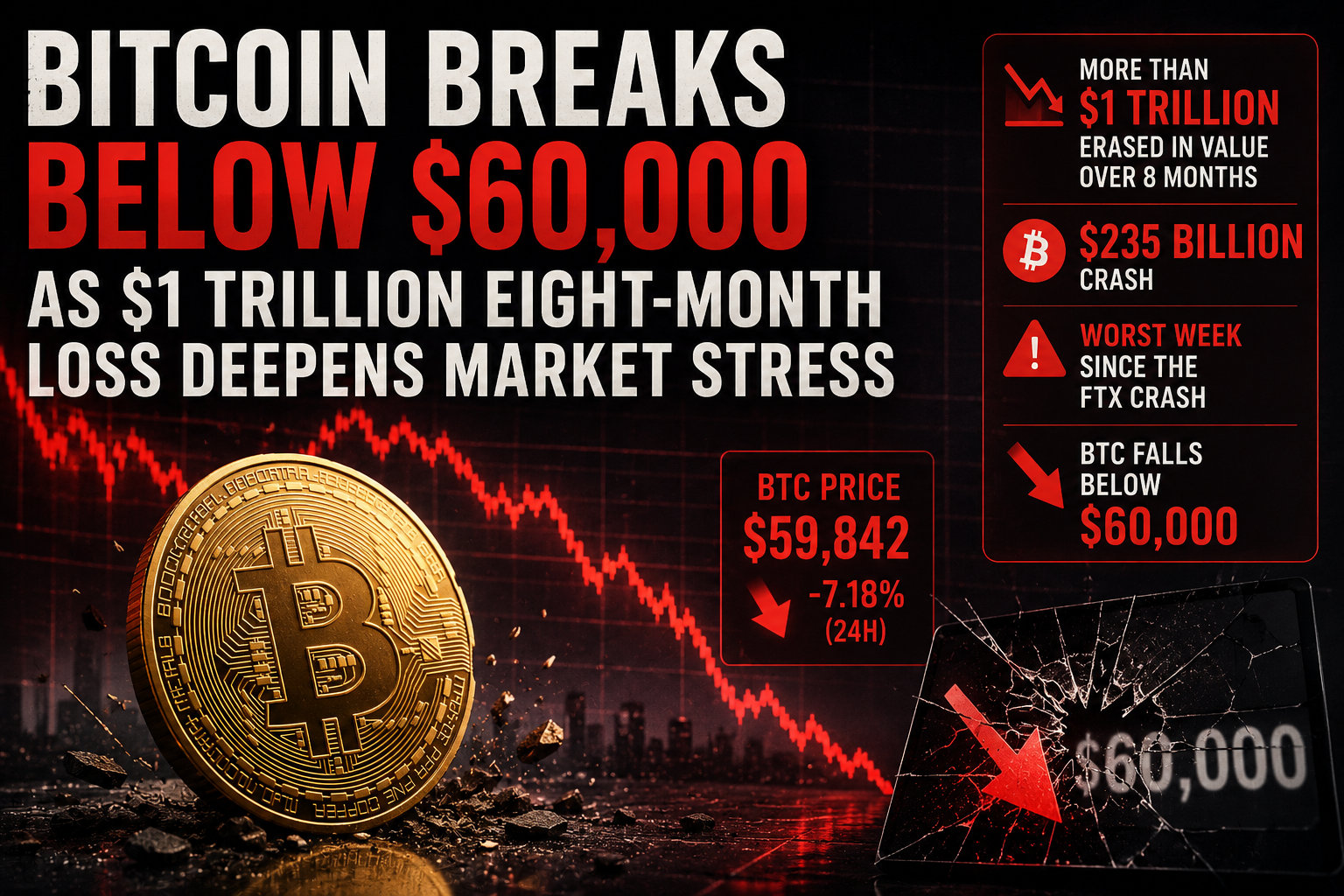
Bitcoin’s selloff has moved from a normal correction into a broader market stress event. The world’s largest cryptocurrency fell below $60,000 in early June 2026, reaching its weakest level since October 2024 and confirming that the decline was no longer just a short-term pullback.
The key market state is clear: Bitcoin is under pressure, investor confidence is damaged, and the asset’s role as the center of crypto liquidity is being tested. Reuters reported that Bitcoin had dropped to around $63,000 after falling about 15% in one week, its sharpest weekly decline since November 2022, when the FTX collapse shook the industry.
That timing matters because FTX remains the benchmark for crypto crisis psychology. When traders compare the latest Bitcoin drop with the FTX period, they are not only comparing price charts. They are comparing stress states: forced selling, weak liquidity, broken confidence and fear that one decline may trigger another.
The $1 Trillion Loss Shows the Scale of Damage
The largest number in this story is not only the sub-$60,000 price break. It is the value destruction behind it. Reuters-linked coverage said Bitcoin had lost more than $1.2 trillion in market capitalization over roughly eight months after hitting a record high near $126,000 in late 2025.
That creates the first major triplet in the story: Bitcoin lost more than $1 trillion in value over eight months. The subject is Bitcoin, the predicate is lost, and the object is market value. This framing matters because it shifts the article from price movement to wealth destruction.
A price drop can look temporary. A trillion-dollar market-cap decline changes investor behavior. Long-term holders reassess conviction, leveraged traders reduce exposure, and institutions become more cautious about adding risk. The decline also weakens Bitcoin’s narrative as an asset that can continue attracting speculative capital regardless of macro conditions.
Breaking Below $60,000 Turns Price Into a Signal
Bitcoin’s move below $60,000 became a psychological line because it marked the first break of that level since October 2024. CoinDesk reported that BTC fell below $60,000 on June 5, 2026, dropping nearly 20% in one week and losing more than 52% from its October 2025 peak above $126,000.
That creates the second core triplet: Bitcoin fell below $60,000. The object is not just a number. It is a market threshold that traders, ETF investors and crypto-linked equity holders can all understand.
Round numbers matter in markets because they concentrate attention. When Bitcoin was above $100,000, the asset carried a momentum story. Below $60,000, the market state changes. Investors begin asking whether Bitcoin is still in a correction, whether it has entered a bear market, or whether forced selling has further to run.
The FTX Comparison Reopens Old Market Fears
The latest selloff was widely compared with Bitcoin’s worst week since the FTX crash. Reuters reported that the weekly drop was the steepest since November 2022, when FTX imploded. Yahoo Finance, carrying Bloomberg coverage, also reported that Bitcoin slumped 16% in the seven days through Sunday, its steepest weekly fall since the FTX bankruptcy triggered a 23% decline in November 2022.
That creates the third triplet: Bitcoin decline marked the worst week since FTX. This comparison gives the selloff historical weight.
The FTX reference matters because that crisis did not only lower prices. It damaged trust in exchanges, counterparties, lenders, venture funding and crypto governance. Today’s selloff is different in cause, but the memory of FTX still shapes how traders react to sharp weekly losses. When Bitcoin falls at a pace last seen during a major industry failure, the market becomes more sensitive to signs of hidden leverage, liquidity strain and forced liquidation.
The $235 Billion Crash Points to a Wider Crypto Shift
Bloomberg Law reported that Bitcoin’s $235 billion crash masked a bigger shift across crypto. The article framed Bitcoin as the former center of gravity for the entire digital-asset economy: when Bitcoin rose, money flowed into startups, venture funds, exchanges and speculative tokens; when it crashed, funding dried up and activity slowed.
That creates the fourth triplet: Bitcoin crash erased $235 billion. But Bloomberg’s framing adds a deeper implication: Bitcoin is no longer the only engine driving crypto activity.
This is important for investors because previous cycles were easier to read. Bitcoin led, altcoins followed, and venture activity moved with BTC liquidity. Now, parts of the crypto market are developing different drivers, including stablecoins, tokenization, exchange infrastructure and crypto-linked financial products. Bitcoin is still the largest asset, but its selloff may no longer explain every corner of the industry.
ETF Outflows Add Pressure to the Price Break
Bitcoin’s price decline also reflects weakening institutional flow. Reuters reported that investors pulled more than $2.7 billion from large Bitcoin ETFs in the week to June 5, bringing 2026 net outflows to about $3.1 billion. That matters because spot Bitcoin ETFs had previously strengthened the institutional adoption narrative.
The triplet here is direct: ETF investors withdrew capital from Bitcoin funds. The result is weaker market support.
When ETF flows are positive, they can absorb supply and give traders confidence that institutional demand remains intact. When those flows turn negative, Bitcoin loses one of its most visible demand channels. The outflows also make the sub-$60,000 break more serious because it suggests the move is not only driven by retail panic or derivatives volatility. Institutional allocators are also reducing exposure.
Strategy’s Bitcoin Sale Damages Corporate Confidence
Another key entity in the selloff is Strategy, the company formerly known as MicroStrategy and the largest corporate holder of Bitcoin. Reuters reported that Strategy disclosed it had sold some Bitcoin holdings for the first time since 2022, while CoinDesk identified Strategy’s shift from major buyer to seller as one of the most important pressures on BTC.
That creates another triplet: Strategy sold Bitcoin. The consequence is confidence damage.
Strategy matters because it has been one of the clearest symbols of corporate Bitcoin conviction. When the company buys, Bitcoin bulls interpret it as confirmation of long-term demand. When it sells, even in small size, traders begin questioning whether the corporate treasury model is under strain. That reaction can be stronger than the sale itself because Strategy’s symbolic role is larger than a single transaction.
AI and Megacap IPOs Pull Attention Away From Bitcoin
The selloff is also connected to a broader capital rotation. Reuters reported that booming AI stocks and upcoming megacap listings such as SpaceX were attracting capital away from Bitcoin. The same report said U.S. semiconductor stocks had surged 170% over the previous year, while Bitcoin had lost 40%.
That creates a different kind of triplet: investors shifted attention from Bitcoin to AI and megacap IPOs. The result is weaker momentum for BTC.
This matters because Bitcoin is partly an attention asset. It performs best when it is the dominant speculative story. In 2026, that role has weakened. AI infrastructure, semiconductor stocks and high-profile IPOs have become the hotter trade. As capital moves toward those themes, Bitcoin loses both liquidity and narrative power.
Bitcoin’s Market Share Is Also Under Pressure
Bitcoin’s stress is not only visible against stocks or IPOs. It is also visible inside crypto. Reuters reported that Bitcoin’s share of the crypto market had fallen from 63% a year earlier to 56%, while stablecoins had grown from about 7% to nearly 13% of the market.
This creates another entity-state relationship: Bitcoin’s dominance weakened while stablecoin share increased.
That matters because stablecoins and other crypto sectors are changing how investors understand the market. Bitcoin remains the flagship asset, but it is no longer the only major story. Stablecoins dominate transaction volume, tokenization is becoming more relevant to institutions, and rival chains compete for activity. Bitcoin’s selloff therefore reflects not only price weakness but also a shift in market structure.
Investor Confidence Is the Real Casualty
The final triplet is the most important: the selloff damaged investor confidence. The object is not only price. It is trust in Bitcoin’s ability to hold leadership during a changing macro and crypto cycle.
Investopedia reported that Bitcoin’s fall below $60,000 placed it down more than 30% for 2026 and below half of its late-2025 record highs. The article also noted that Strategy shares had lost more than 20% in 2026, while Coinbase had lost about one-third of its value. This shows that the selloff has spread from Bitcoin itself into crypto-linked equities.
That transmission matters. When BTC falls, listed crypto companies, ETFs, miners, exchanges and treasury firms can all come under pressure. That can create a feedback loop in which falling Bitcoin weakens crypto equities, and weaker crypto equities damage confidence in the broader sector.
Capitulation or More Downside?
The central question now is whether Bitcoin’s decline marks capitulation or the start of another leg lower. A capitulation argument would point to the scale of the damage: more than $1 trillion in market value erased, a break below $60,000, the worst weekly decline since FTX and deep pessimism across crypto-linked assets.
But the bearish argument remains strong. ETF outflows are still a drag, AI and IPO trades are pulling capital away, and Strategy’s sale has shaken confidence in the corporate treasury bid. If Bitcoin cannot reclaim major levels quickly, traders may treat rebounds as temporary relief rather than a confirmed bottom.
Because of that setup, Bitcoin is now in a test phase. A recovery above $60,000 would help restore some confidence, but it would not erase the broader damage. The market likely needs stronger ETF inflows, renewed corporate demand, lower macro pressure and a fresh narrative catalyst before investors can say the selloff has truly ended.
For now, Bitcoin’s break below $60,000 is more than a price event. It is a signal that the asset’s liquidity base, institutional demand, market leadership and investor confidence are all being tested at once.